

Imagine you’re reading a research paper and come across a term you’ve never seen before:
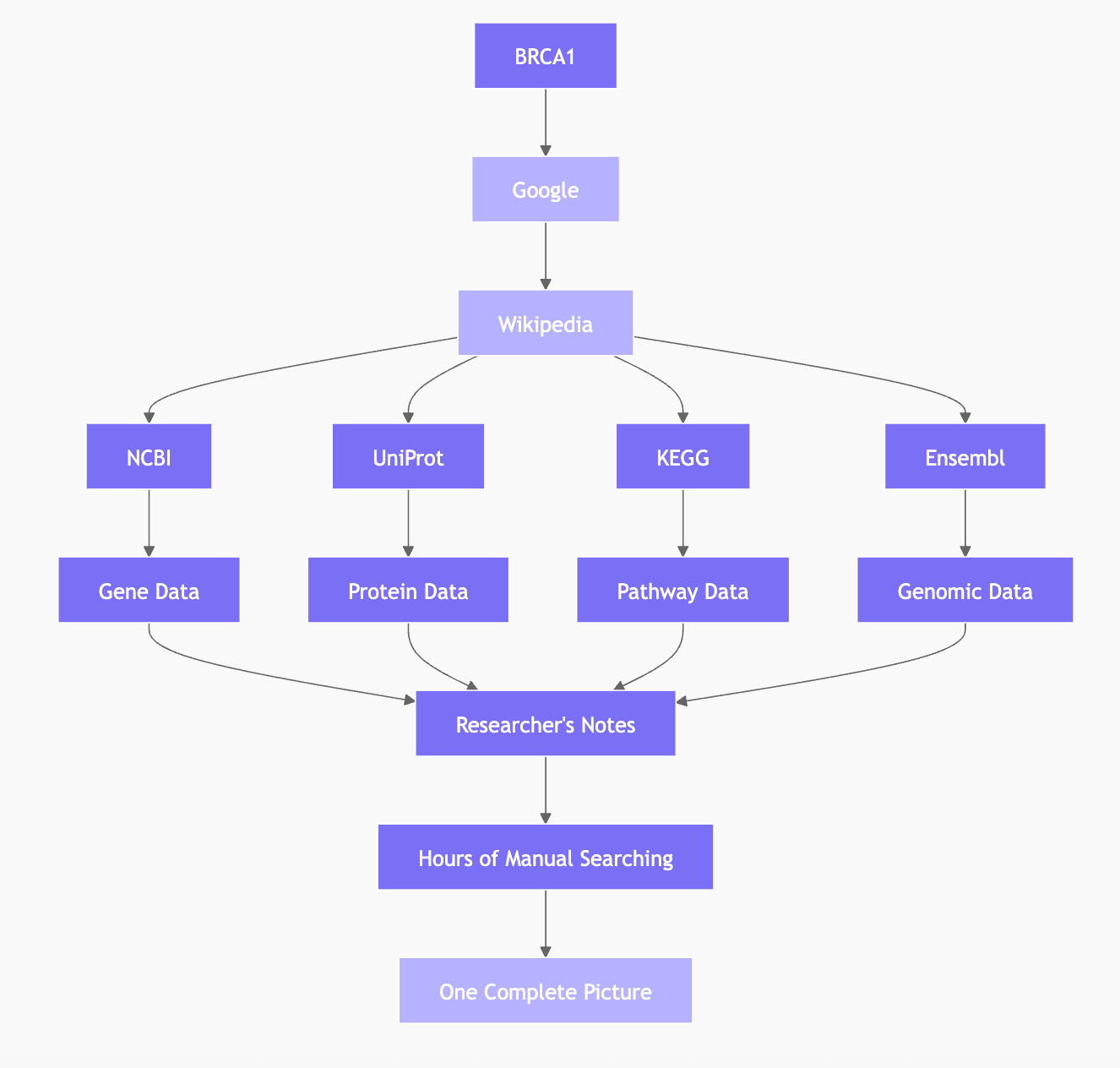
BRCA1
You copy it into Google → Wikipedia appears. Useful, but not exactly what you’re looking for.
You click into one of the vast array of biological databases (NCBI, UniProt, KEGG, and the list goes on). Search again.
You find the gene page for BCRA1.
Now you need information about the protein it produces, so you open another database and search again. Then another, and another. Hours later, you’ve assembled the information you needed.
FOR ONE GENE.
This might sound surprising if you’ve never worked with biological data, but modern biology has a search problem.
The Auto-Detect System
What if you didn’t have to decide where to search?
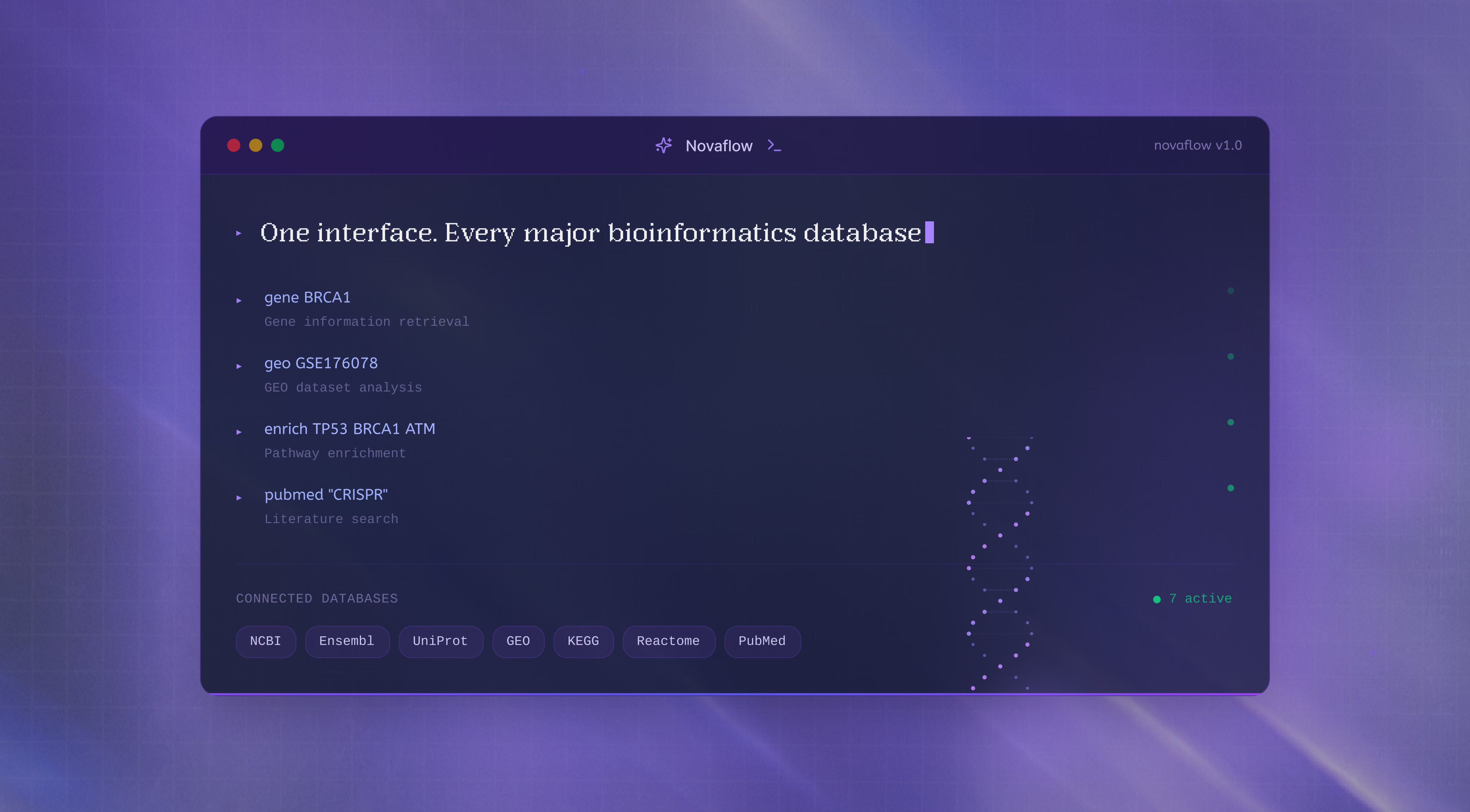
That question led to novaflow. Instead of asking users which database they want to search, novaflow looks at the input and determines what is first.
Let’s say a Molecular Biologist is wondering → “What does BRCA1 do?”→ “What genes/proteins are affected when BRCA1 is inactive?”
If they input:
BRCA1BRCA1 matches the pattern of a gene symbol tied to Breast Cancer Gene 1. Novaflow automatically routes the query to NCBI (broad biological database), Ensembl (Genome-focused database), and UniProt (Protein-focused database).
If they input:
rs104893877Novaflow recognizes it as an rsID, a common identifier for genetic variants, and routes the search to dbSNP and ClinVar (genetic databases).
If they input:
4HHBit recognizes a Protein Data Bank identifier and fetches the structure.
Over the last few decades, scientists have generated an extraordinary amount of biological data. We’ve sequenced genomes, mapped proteins, cataloged diseases, stored gene expression experiments, and determined the three-dimensional structures of thousands of molecules.
The information is out there and in abundance; the challenge is finding the desired information for researchers.
Researchers often move between specialized databases such as:
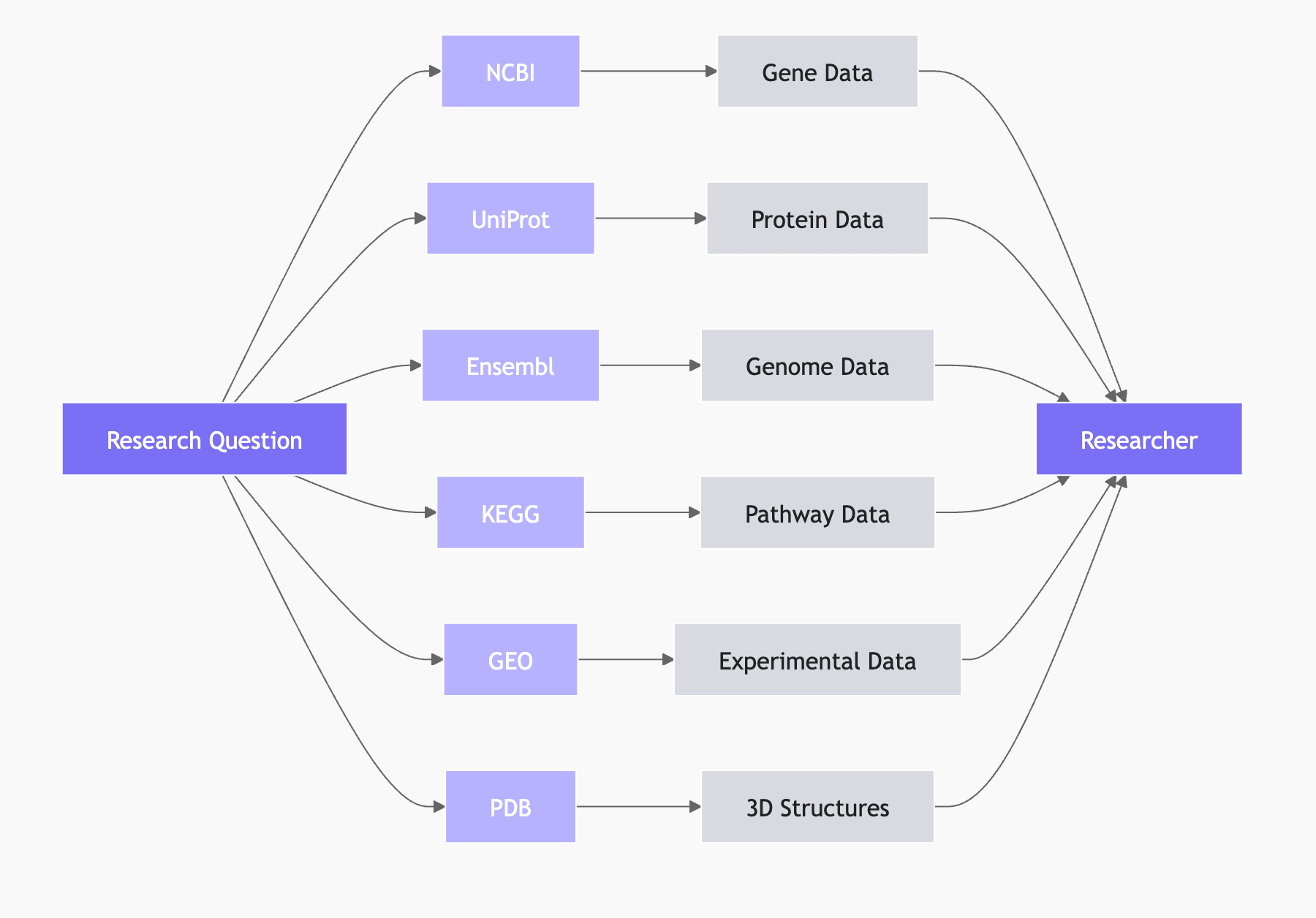
Each database serves an important purpose. But finding information often means manually hopping between them, searching for the same thing repeatedly. We kept asking ourselves a simple question:
Why can’t biological search work more like Google?
So We Built It!
The idea sounds simple: type what you have and let the software connect all the dots. The challenge is teaching a command-line tool how to recognize and synthesize the correct biological identifiers for different scenarios
Different types of biological data follow different patterns. For example, Gene symbols look different from protein structure identifiers and variant IDs. Novaflow starts by using regex pattern matching and priority routing to determine the most likely match. Once it identifies the input, it sends concurrent API requests to the relevant databases.
Instead of waiting for one database at a time, Novaflow queries multiple sources simultaneously. The results are then merged, deduplicated, and formatted into a single terminal-friendly response
What’s Next?
Today, Novaflow is optimized for individual lookups. You type an identifier, Novaflow determines what it is, and returns the relevant information.
Next, we’re expanding into larger workflows.
One area we’re excited about is batch enrichment. Instead of looking up a single gene, researchers will be able to pass in an entire gene list:
enrich genes.txtWe’re also working on deeper integration with existing analysis pipelines, making it easy to pipe Novaflow output directly into R and Python workflows.
Finally, we’re expanding support beyond human datasets to support additional organisms and research applications.
Our long-term goal is straightforward: make biological information retrieval as seamless as possible, whether you’re exploring one gene or ten thousand.
Try It
Enterprise teams get unlimited access. Click here for a demo!